
EU businesses concerned about ambiguity of Chinese data laws
- September 19, 2023
- Posted by: Quatro Strategies
- Categories: Business & Politics, China, Europe, Sanctions & Regulation
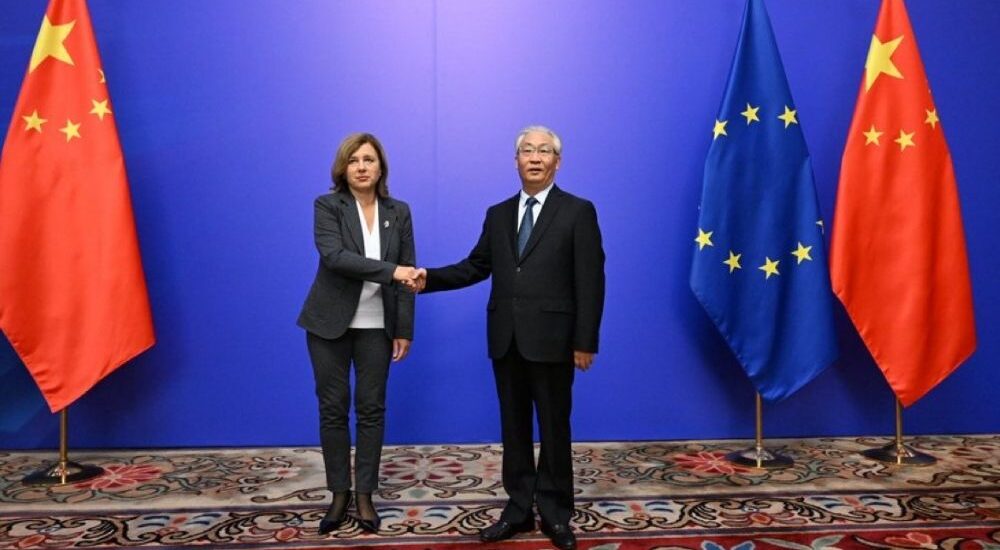
European Union businesses are increasingly expressing their apprehensions about China’s data laws, citing concerns about their lack of clarity and the extensive processes that companies have to navigate, according to European Commission Vice President Vera Jourova. In a move in July, China broadened its counter-espionage law to prohibit the transfer of any information related to national security and interests. However, what adds to the uncertainty is that these critical terms are not adequately defined, making it challenging for businesses to determine the boundaries set by the law.
Moreover, the definition of spying has been expanded to include cyberattacks against state organs or critical infrastructure, adding another layer of complexity and ambiguity.
Chinese President Xi Jinping’s growing emphasis on national security, especially the crackdown on consultancies and due diligence firms, has left many foreign companies unsure about where they might cross the line of the law. This lack of clarity regarding what constitutes important data and how the law could be contravened is a significant cause for concern.
Another aspect adding to the complexity is the prolonged time taken to complete procedural matters; some processes reportedly extend up to 45 days, and often even longer. These factors create a challenging environment for businesses trying to navigate China’s evolving data laws and regulatory landscape.
Jourova, speaking after co-chairing the first EU-China High-level Digital Dialogue in three years, highlighted the necessity for clear communication channels between China and Europe, particularly in areas of disagreement. She emphasized the importance of China and Europe maintaining open communication in various degrees, considering that China plays roles as a partner, competitor, and systemic rival.
In late July, the Chinese commerce ministry briefed representatives from the US, Europe, Japan, South Korea, and several foreign firms about the new anti-espionage law. The ministry stated that China is committed to creating a fair, transparent, and predictable business environment.
However, the lack of clarity and well-defined parameters in the data laws continues to be a source of anxiety for EU businesses operating in or with China. To address this, Jourova suggested creating an information link that would help EU businesses understand the law better and ensure compliance, demonstrating the need for enhanced transparency and a clearer regulatory framework in this evolving digital landscape.
By QUATRO Strategies International Inc.
QUATRO Strategies International Inc. is the leading business insights and corporate strategy company based in Toronto, Ontario. Through our unique services, we counsel our clients on their key strategic issues, leveraging our deep industry expertise and using analytical rigor to help them make informed decisions to establish a competitive edge in the marketplace.
Interested in learning more?
Sign up for Top Insights Today

Top Insights Today delivers the latest insights straight to your inbox.
You will get daily industry insights on
Oil & Gas, Rare Earths & Commodities, Mining & Metals, EVs & Battery Technology, ESG & Renewable Energy, AI & Semiconductors, Aerospace & Defense, Sanctions & Regulation, Business & Politics.
Read more insights

China’s return as a major zinc importer reshapes global trade dynamics
Last year marked a significant turning point in the global trade dynamics of refined zinc, with China resuming its role as a major net importer after a brief period of inversion observed in 2022. This reversal in trade flows was driven by a combination of factors, including the closure of Western…

Aluminum prices experience rally as EU mulls sanctions on Russian metal
Aluminum prices in London experienced a rally following suggestions that the European Union is contemplating sanctions on Russian aluminum, particularly ahead of the second anniversary of the invasion of Ukraine. The prices surged up to 3.6% on the London Metal Exchange as concerns over…
Europe re-enters Africa’s power game with $2B EIB pledge
The European Investment Bank is lining up a significant new push into Africa’s clean energy space, committing more than 2 billion euros in financing for renewable power projects across the continent over the next two years.
According to the bank, the money will support not just new generation capacity in hydropower, solar and wind, but also the often-overlooked backbone of any energy transition: the grids and networks needed to move electricity reliably to households, businesses and industry.