
Biden to visit Vietnam next month to discuss broad range of issues
- August 29, 2023
- Posted by: Quatro Strategies
- Categories: Asia Pacific, Business & Politics, United States
Next month, US President Joe Biden will visit Vietnam to discuss various topics with top officials, including technology, economy, regional stability, and climate change. The goal is to strengthen ties between the two countries, especially since China holds a significant position in the region.
Biden is scheduled to meet with Communist Party General Secretary Nguyen Phu Trong and other senior Vietnamese leaders in Hanoi on September 10th. Afterward, he will travel to Alaska to commemorate the September 11th attacks.
The US aims to improve its relationship with Vietnam, viewing it as a valuable partner in the region. However, Vietnam must also consider China’s reaction as it becomes more assertive. Biden’s administration hopes to strengthen US ties in Asia. Biden will travel to Vietnam from India, where he will attend the G20 summit from September 7-10. He will not attend the ASEAN meetings next month and will send Vice President Kamala Harris instead.
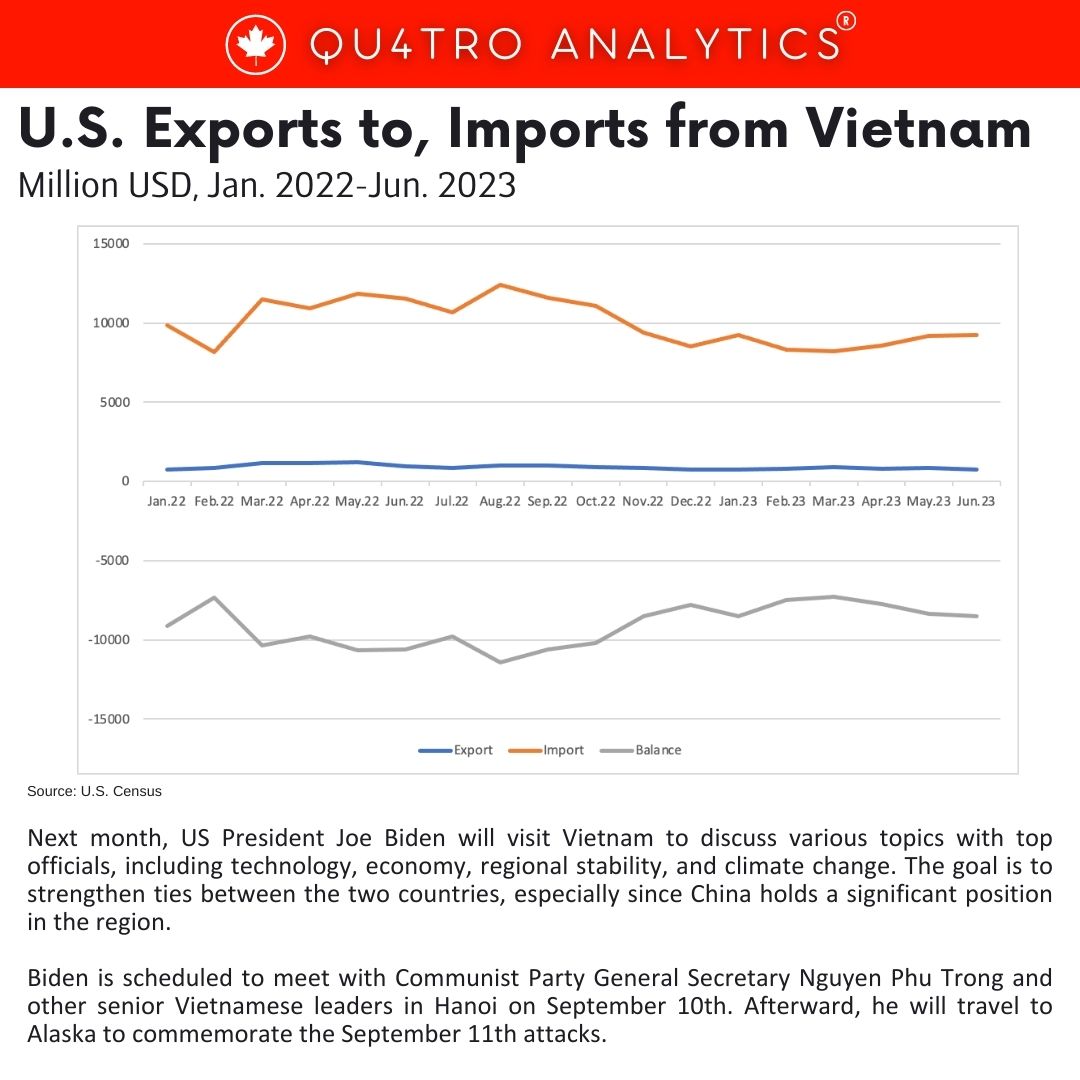 Diplomats expressed disappointment that Biden will not attend the ASEAN summit in Jakarta. While in Hanoi, Biden and Vietnamese officials will discuss ways to deepen their relationship and strengthen Vietnam’s technology-driven economy.
Vietnam’s Foreign Ministry stated that the visit would strengthen Vietnam-US relations. Foreign Ministry spokesman Pham Thu Hang said that the visits would contribute to peace, stability, and cooperation in the region and the world.
The US views Vietnam as an important partner in the region. Biden and Trong spoke by phone in March, and US Secretary of State Antony Blinken visited Vietnam a month later. The US is Vietnam’s largest export market, and this year marks the 10th anniversary of their “comprehensive partnership.”
Trong, who is considered Vietnam’s most powerful figure, met with Chinese President Xi Jinping in Beijing last year after Xi won an unprecedented third term.
Interested in learning more?
Sign up for Top Insights Today

Top Insights Today delivers the latest insights straight to your inbox.
You will get daily industry insights on
Oil & Gas, Rare Earths & Commodities, Mining & Metals, EVs & Battery Technology, ESG & Renewable Energy, AI & Semiconductors, Aerospace & Defense, Sanctions & Regulation, Business & Politics.
Read more insights
China calls exporters to Beijing as metals controls tighten
A major Chinese metals trade body is convening a closed-door style policy and compliance briefing in Beijing on March 25 that, in practical terms, looks like an effort to operationalize Beijing’s tightening export-control regime for rare earths and a wider set of “strategic” metals.
The China Chamber of Commerce of Metals, Minerals & Chemicals Imports & Exports will bring in officials from the Commerce Ministry and the customs authority to walk companies through export-control rules, customs clearance procedures, and compliance expectations, while also providing an official readout on China-U.S. trade dynamics and the direction of foreign-trade policy as China enters its next five-year planning cycle.
UK hardens steel trade defenses in strategic industry shift
Britain is preparing to harden its steel trade defenses in what looks like a significant shift toward a more openly protectionist industrial policy. The government is expected to cut import quotas for many steel products and raise tariffs on shipments outside those limits to 50%, roughly bringing the UK into line with the European Union and the United States.
The move would form part of a broader steel strategy expected shortly from the government, which has already made clear that it sees the survival of domestic steelmaking as a strategic priority rather than simply a matter of market efficiency.
Beijing to impose absolute emissions caps by 2030 in carbon market overhaul
China is moving to dramatically expand and tighten its national carbon market, accelerating its climate timetable and bringing new industrial sectors under regulation well before originally planned. According to guidelines issued Monday by the Communist Party Central Committee and the State Council, Beijing will extend the scheme to cover steel, aluminum, and cement in 2025 and will add all major industries by 2027, three years ahead of schedule.
By 2030, China intends to have created a “transparent, standardized, and internationally aligned voluntary reduction market” alongside binding caps on total emissions, a tougher measure than the current system based on carbon intensity.