
Japan looking to spend record $52.67 billion on defense in 2024
- August 31, 2023
- Posted by: Quatro Strategies
- Categories: Aerospace & Defense, Asia Pacific, China
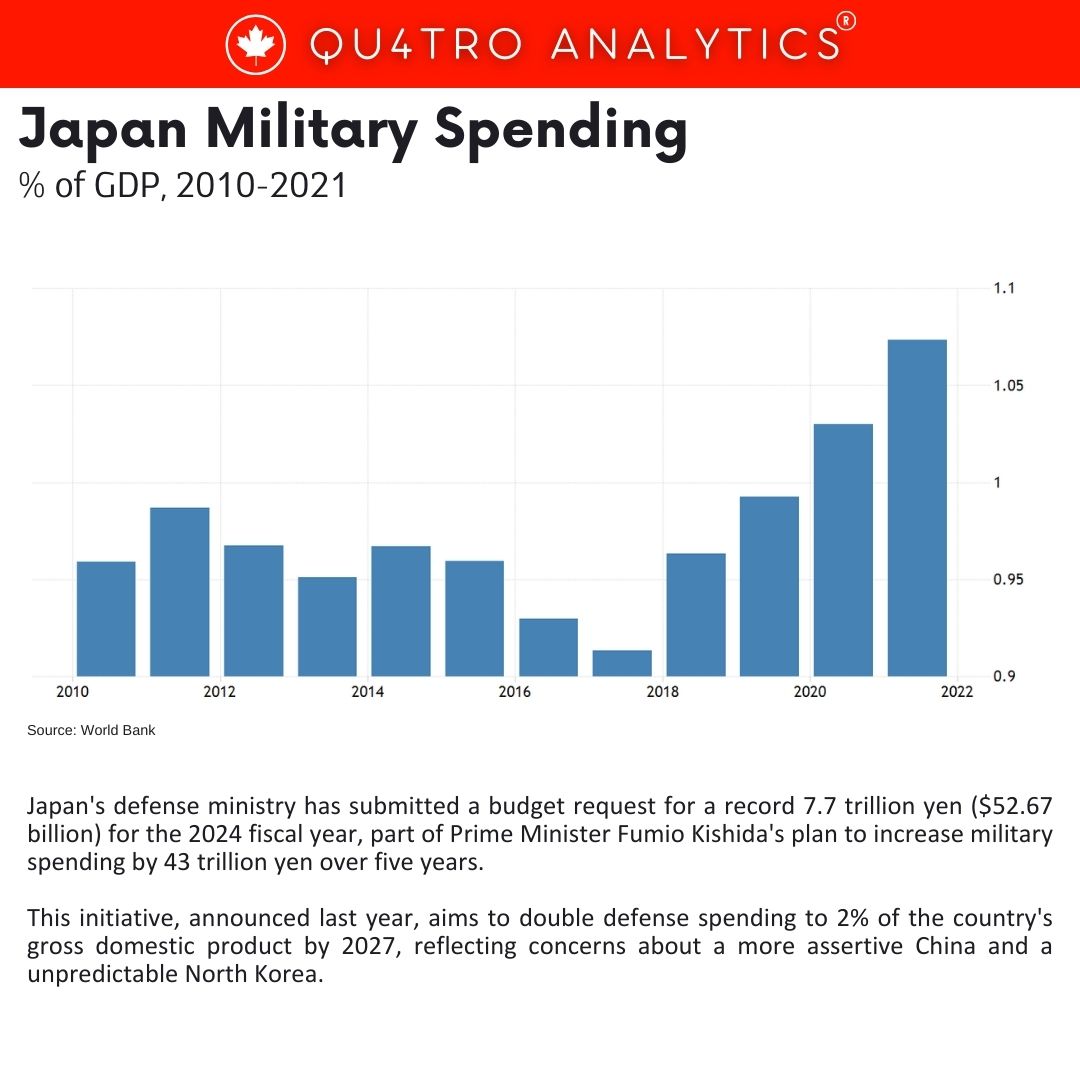
Japan’s defense ministry has submitted a budget request for a record 7.7 trillion yen ($52.67 billion) for the 2024 fiscal year, part of Prime Minister Fumio Kishida’s plan to increase military spending by 43 trillion yen over five years. This initiative, announced last year, aims to double defense spending to 2% of the country’s gross domestic product by 2027, reflecting concerns about a more assertive China and a unpredictable North Korea.
The proposed budget, if approved, would represent an increase of almost a trillion yen from the previous year’s budget of 6.8 trillion yen, marking a rise of about 13%. This would be the second consecutive year of unprecedented budget increases.
Within the budget request, the defense ministry plans to allocate over 900 billion yen for ammunition and weapons, including ship-based air-defense missiles. Approximately 600 billion yen will be dedicated to enhancing logistics capabilities for deploying weapons and resources to southwest island chains in case of emergencies.
 The budget includes funding for new landing ships worth 17 billion yen, over 300 billion yen for 17 transport helicopters, and resources for creating a new specialized transport team to enhance deployment capabilities.
Japan will allocate 75 billion yen for joint development with the United States on interceptor missiles designed to counter hypersonic warheads, and 64 billion yen for the joint development of next-generation fighter jets with Britain and Italy.
This surge in defense spending, driven by concerns about China’s increasing military assertiveness and North Korea’s activities, represents a departure from Japan’s historically pacifist policies. While the country has emphasized that its growing military capabilities will not be used for threatening others, this shift in defense posture has been driven by evolving regional dynamics, including China’s maritime ambitions, North Korea’s military actions, and Russia’s actions in Ukraine.
Interested in learning more?
Sign up for Top Insights Today

Top Insights Today delivers the latest insights straight to your inbox.
You will get daily industry insights on
Oil & Gas, Rare Earths & Commodities, Mining & Metals, EVs & Battery Technology, ESG & Renewable Energy, AI & Semiconductors, Aerospace & Defense, Sanctions & Regulation, Business & Politics.
Read more insights

Teck’s germanium push aims to fortify U.S.-Canada critical mineral alliance
Teck Resources, one of the leading producers of germanium outside China, is actively exploring an expansion of its production capacity amid growing geopolitical competition over strategic minerals. The Vancouver-based miner is currently in discussions with both the Canadian and U.S. governments regarding potential public funding to support this effort.
The push by Teck to scale up germanium output comes at a time when Western governments are increasingly prioritising the development of secure supply chains for critical minerals essential to modern technologies, including semiconductors, telecommunications, defence systems, and clean energy infrastructure.

Hedge funds ramp up tech buying as earnings season kicks off
This week, global hedge funds aggressively bought U.S. information technology stocks, especially in semiconductors and hardware, marking the fastest purchasing activity in this sector in five months. This spike in activity coincided with the start of the third-quarter earnings season. The tech buying spree occurred…
Vietnam’s export engine jolted by Trump’s 46% tariff threat
The effects of the Trump administration’s tariff shockwaves are playing out with whiplash speed in Vietnam’s export sector, as factory floors alternate between a sprint and a standstill depending on the product and destination. Industry executives and local surveys reveal a chaotic landscape: some manufacturers have been ordered to drastically ramp up production for U.S. shipments, while others are cutting shifts or freezing expansion plans as American buyers hesitate amid the trade uncertainty.
This volatility reflects the disruptive impact of the sweeping 46% tariffs President Trump announced earlier this month on Vietnamese goods, most of which were paused on April 9 for a 90-day window while negotiations with U.S. trading partners continue. That pause, while welcomed, has done little to stabilize operations, with exporters unsure whether to scale up output for a boom—or hunker down for a bust.