
Shell looking to invest in Indian renewable assets
- September 22, 2023
- Posted by: Quatro Strategies
- Categories: ESG & Renewable Energy, India

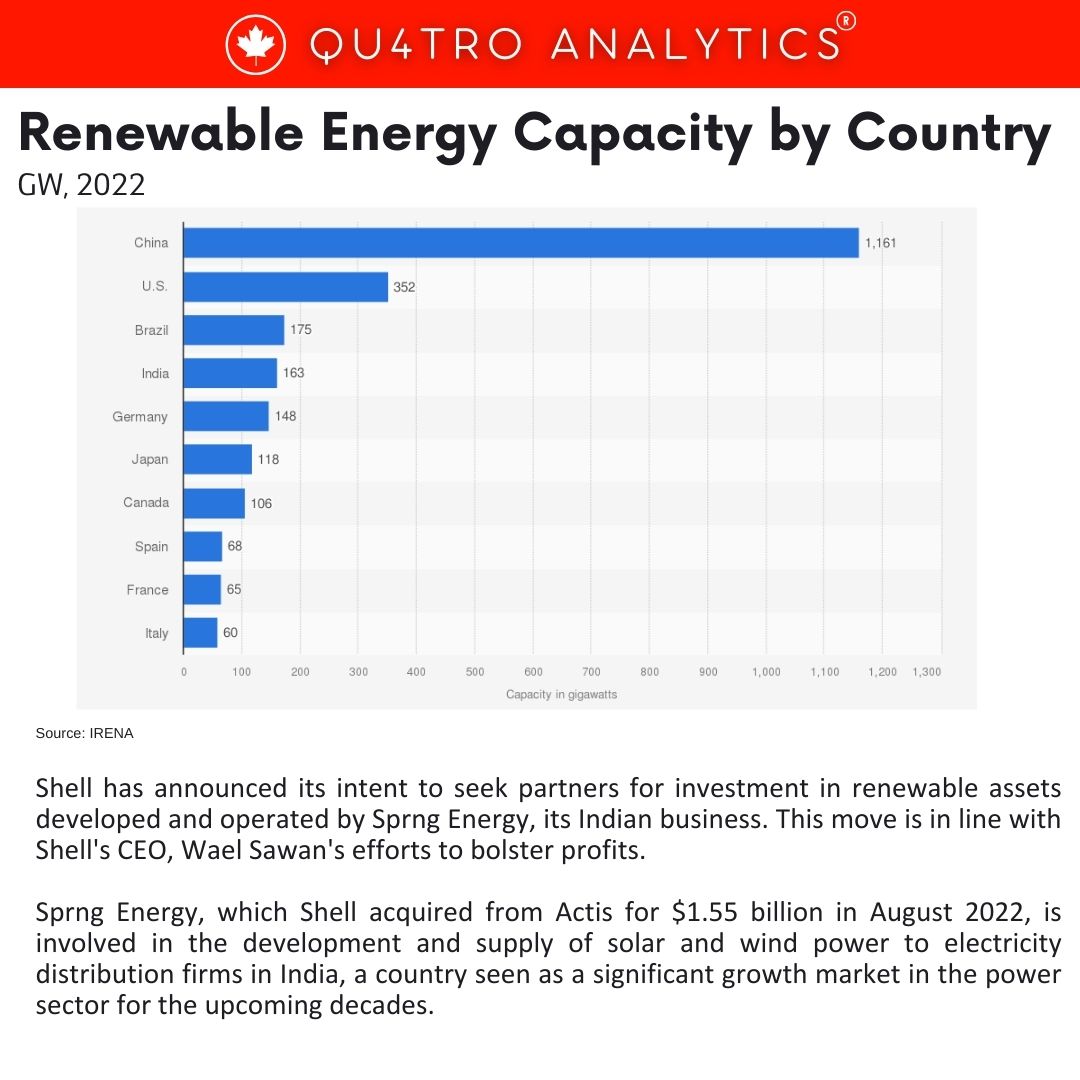
Shell has announced its intent to seek partners for investment in renewable assets developed and operated by Sprng Energy, its Indian business. This move is in line with Shell’s CEO, Wael Sawan’s efforts to bolster profits. Sprng Energy, which Shell acquired from Actis for $1.55 billion in August 2022, is involved in the development and supply of solar and wind power to electricity distribution firms in India, a country seen as a significant growth market in the power sector for the upcoming decades.
Shell expressed its ongoing commitment to developing new projects within the Sprng Energy group while actively exploring partnership opportunities with investors eager to invest in de-risked operational assets. The objective is to have Shell retain a stake in these assets. By focusing on capital discipline, Shell aims to accelerate the growth of its renewables portfolio.
 Sawan’s strategy involves enhancing Shell’s performance and returns, which includes a strengthened emphasis on oil and gas operations and a reduction in certain investments in renewables. Recent actions reflecting this strategy include the sale of Shell’s UK power retail business, putting two refineries in Singapore and Germany under strategic review, and exiting several low-carbon projects.
However, this strategy has faced criticism from climate-focused investors, and there has been notable personnel change within Shell’s renewable generation division, with Thomas Brostrom, the head of renewable generation, leaving the company in June.
By QUATRO Strategies International Inc.
QUATRO Strategies International Inc. is the leading business insights and corporate strategy company based in Toronto, Ontario. Through our unique services, we counsel our clients on their key strategic issues, leveraging our deep industry expertise and using analytical rigor to help them make informed decisions to establish a competitive edge in the marketplace.
Interested in learning more?
Sign up for Top Insights Today

Top Insights Today delivers the latest insights straight to your inbox.
You will get daily industry insights on
Oil & Gas, Rare Earths & Commodities, Mining & Metals, EVs & Battery Technology, ESG & Renewable Energy, AI & Semiconductors, Aerospace & Defense, Sanctions & Regulation, Business & Politics.
Read more insights

MP Materials, Ma’aden forge Saudi hub for heavy rare earths refining
MP Materials is stitching together a new rare earths hub in Saudi Arabia, teaming up with Riyadh’s state miner Ma’aden, and strikingly, Washington itself. The plan is to build a refinery inside the kingdom that can take mixed concentrates from Saudi deposits and elsewhere and separate them into high-value oxides across the spectrum of “light” and “heavy” rare earths.
Under the structure announced, Ma’aden will hold a controlling 51% stake, while MP and the U.S. government, already set to become MP’s largest shareholder through a Pentagon investment, will jointly own the remaining 49%. The timing coincides with Crown Prince Mohammed bin Salman’s Washington visit and signals that energy and security ties are being recast around critical minerals, not just oil.
Metals industry asks the EU to invest more in minerals processing
Metal producers and consumers in Europe have urged the European Union (EU) to increase its investments in expanding processing capacity for critical minerals necessary for the energy transition, including those used in electric vehicles.

EU considers more flexible gas storage law to balance market risks and supply security
European Union countries are negotiating changes to the bloc’s gas storage regulations that could loosen this year’s winter fuel obligations—if the new rules are finalised in time. The ongoing talks focus on reforming the bloc’s gas storage targets for 2026 and 2027.
A key change under discussion is replacing the current binding requirement to fill gas storage sites to 90% by November 1 with a more flexible timeframe—allowing countries to reach the 90% level at any point between October 1 and December 1. While this shift is intended for future years, EU diplomats say the revised schedule could also apply in 2025, provided the new law is finalised and published in the EU’s official journal before November 1 of this year.