
India’s crude oil imports from Russia rebound in September
- October 2, 2023
- Posted by: Quatro Strategies
- Categories: Europe, India, Oil & Gas

Cheaper Russian crude compared to Middle Eastern alternatives has led Indian refiners to increase their crude oil imports from Russia in September compared to a seven-month low in August, according to preliminary tanker-tracking data. India, the world’s third-largest oil importer, welcomed around 1.55 million barrels per day (bpd) of Russian oil in September, up by 16% compared to August.
This rebound occurred due to a tighter market and more expensive crude from the Middle East, including from Saudi Arabia, which has been raising its contractual selling prices for Asia.
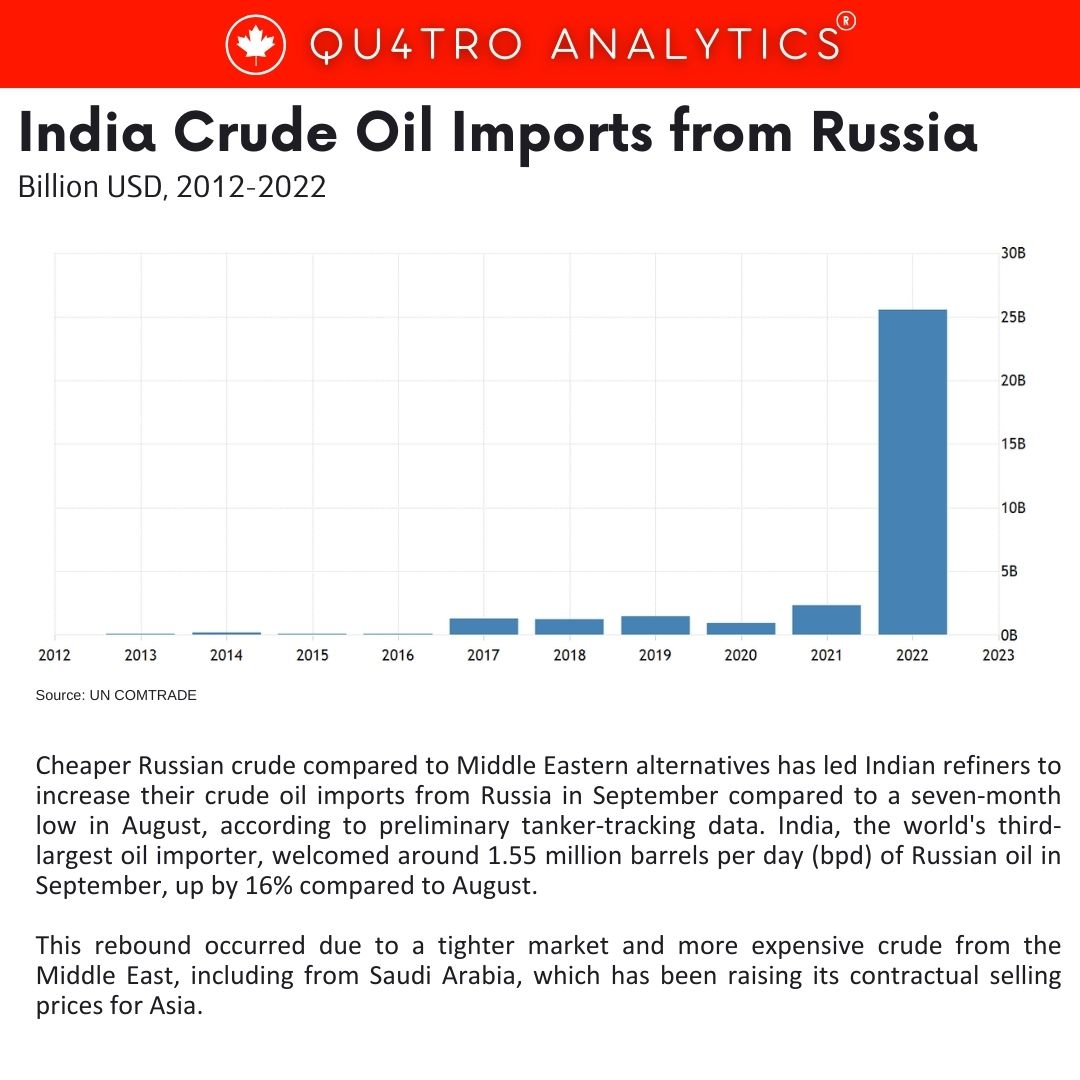 Russian grades are cheaper on the spot market than Middle Eastern crude in term contracts. With recent hikes in Saudi prices, Indian refiners are more inclined to buy Iraq’s Basrah Medium, which is approximately $2 a barrel cheaper than Saudi Arabia’s Arab Light and Arab Medium.
Despite the recent increase, Russian crude is still cheaper by over $10 per barrel compared to grades from the Middle East.
In recent days, tightening global crude supply and rising international prices have raised the price at which Russia’s crude is being sold to India to about $20 per barrel over the G7 price cap of $60.
The Russian flagship crude grade, Urals, is being sold to one of Moscow’s top two customers, India, at nearly $80 per barrel. This price, although higher, is still comparatively lower than Middle Eastern grades.
QUATRO Strategies International Inc. is the leading business insights and corporate strategy company based in Toronto, Ontario. Through our unique services, we counsel our clients on their key strategic issues, leveraging our deep industry expertise and using analytical rigor to help them make informed decisions to establish a competitive edge in the marketplace.
Interested in learning more?
Sign up for Top Insights Today

Top Insights Today delivers the latest insights straight to your inbox.
You will get daily industry insights on
Oil & Gas, Rare Earths & Commodities, Mining & Metals, EVs & Battery Technology, ESG & Renewable Energy, AI & Semiconductors, Aerospace & Defense, Sanctions & Regulation, Business & Politics.
Read more insights
Indian Prime Minister Modi sets ambitious goal of $6.69 trillion economy by 2030
Indian Prime Minister Narendra Modi is aiming for an ambitious economic target, aiming to roughly double the country’s economy and exports by the end of this decade. Modi has been emphasizing economic growth as a major achievement in his election rallies, expressing confidence in making…
EU draws battle plan with drone lattice next year, eastern shield by 2028
Brussels has sketched out its most muscular vision yet of a Europe that can defend itself, unveiling a slate of flagship programs that range from a continent-wide anti-drone lattice to hardening the EU’s exposed eastern frontiers.
Framed as a “roadmap” rather than a press-release wish list, the package sets aggressive clocks: an initial operational layer for both a European Drone Defence Initiative and an “Eastern Flank Watch” by the end of next year, full drone capability a year after, and a fortified land-air-sea shield on the eastern rim by 2028.
Kazakhstan’s uranium output reduction sparks interest in new supply agreements
Uranium project developers are witnessing a more optimistic outlook for prices and demand for supply agreements following significant developments in the market, notably the decision by Kazakhstan, the world’s leading uranium producer, to reduce its output. Recent discussions with…