
Mali unveils new law to ramp up gold mining revenue
- August 30, 2023
- Posted by: Quatro Strategies
- Categories: Africa, Mining & Metals, Rare Earths & Commodities
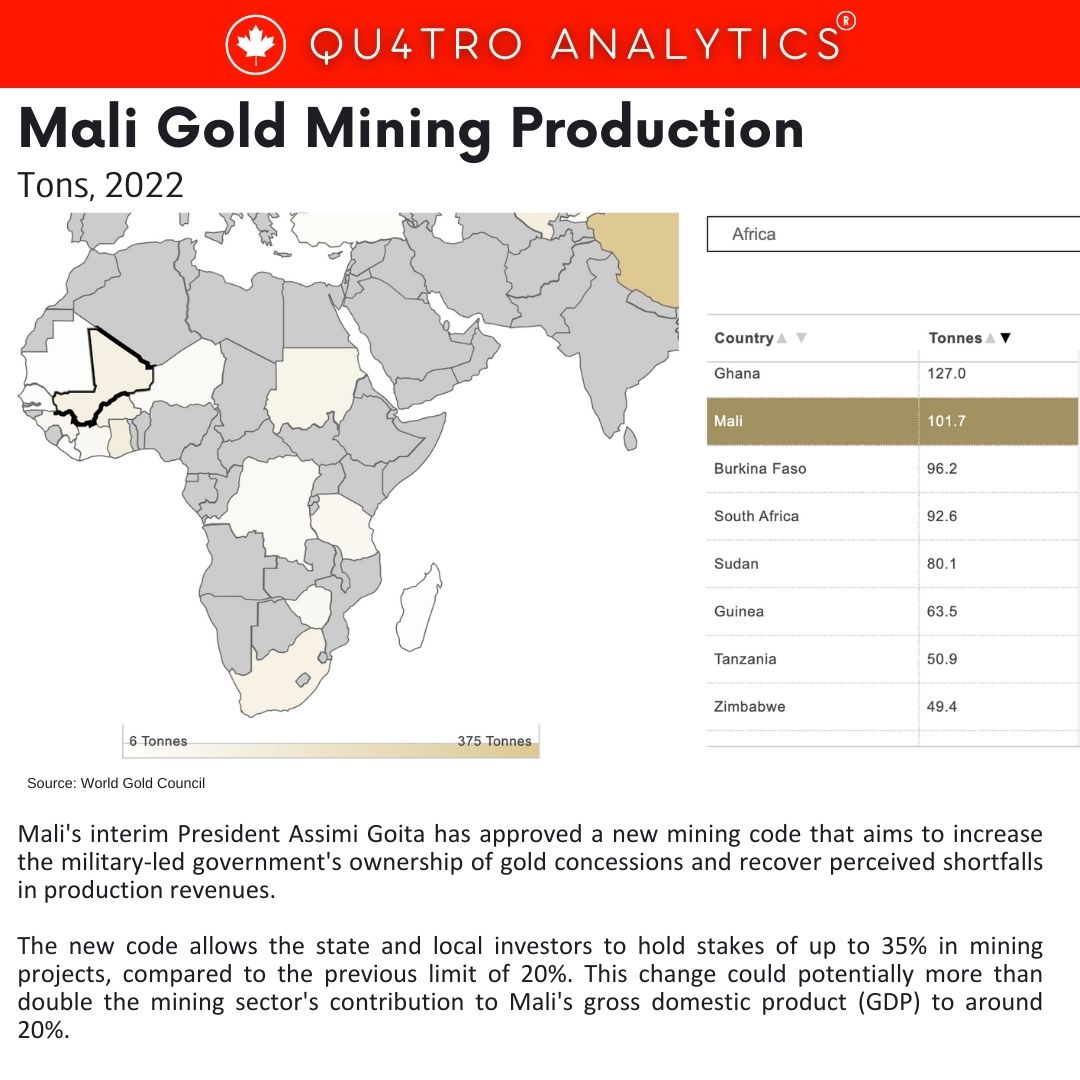
Mali’s interim President Assimi Goita has approved a new mining code that aims to increase the military-led government’s ownership of gold concessions and recover perceived shortfalls in production revenues. The new code allows the state and local investors to hold stakes of up to 35% in mining projects, compared to the previous limit of 20%. This change could potentially more than double the mining sector’s contribution to Mali’s gross domestic product (GDP) to around 20%.
The specifics of how the new mining code will affect existing projects are yet to be clarified, as this will depend on the implementing decrees, which have not been released. Mali is a significant gold producer in Africa, hosting companies like Barrick Gold, B2Gold, Resolute Mining, and Hummingbird Resources.
 Mali’s Finance Minister Alousseni Sanou stated that an audit of the mining sector revealed a shortfall of 300 billion to 600 billion CFA francs (approximately $497 million to $995 million), which the government intends to recover. Sanou explained that negotiations with mining companies could potentially lead to recouping a substantial portion of the shortfall.
The new mining code also aims to address issues such as mining companies transporting gold ore to tax-exempt mines for processing and tighten the issuance of mining titles. The move is part of Mali’s broader efforts to increase transparency, inclusiveness, and revenue from its mining sector.
President Assimi Goita came to power after overthrowing two presidents in 2020 and 2021 due to dissatisfaction with the handling of an Islamist insurgency. He has pledged to organize elections and transfer power to civilian rule by 2024.
Interested in learning more?
Sign up for Top Insights Today

Top Insights Today delivers the latest insights straight to your inbox.
You will get daily industry insights on
Oil & Gas, Rare Earths & Commodities, Mining & Metals, EVs & Battery Technology, ESG & Renewable Energy, AI & Semiconductors, Aerospace & Defense, Sanctions & Regulation, Business & Politics.
Read more insights
Germany’s €500 billion growth plan tempts European firms away from U.S. expansion
European corporate leaders who once feared missing out on the Trump boost are now reassessing their strategies as Germany’s election winner, Friedrich Merz, signals a shift in fiscal policy that could supercharge Europe’s growth. The long-standing outperformance of the U.S. economy and stock market had made America the preferred destination for European investment, but that calculus is beginning to shift.
At the end of 2024, the S&P 500 Index surged nearly 25%, helped in part by Trump’s election victory, which fueled expectations of deregulation and economic acceleration. The International Monetary Fund (IMF) projects U.S. growth at 2.7% this year, compared to a sluggish 1% for the eurozone, and Germany entered a recession.
Shanghai copper sees busiest session in decade as funds pile in
China’s commodity complex is sending a signal that is as much about finance as it is about factories: investors are treating industrial metals as the most liquid way to express macro views on growth, inflation hedging, and geopolitical fracture, and they are doing so at a scale that is beginning chinese exchange specific rather than purely global.
Trading activity on the Shanghai Futures Exchange (SHFE) has surged into territory that looks less like routine hedging and more like a broad-based speculative migration into raw materials. In December, turnover across SHFE’s six base-metals futures contracts, together with gold and silver, reached about 37.1 trillion yuan, over $5 trillion, more than triple the level of a year earlier.
Niger freezes new mining licenses, launches audit for economic reforms
Niger has initiated a temporary suspension of new mining licenses as the first step in an audit of its mining sector, with the goal of enhancing government revenue. The country, known for being one of the top global producers of uranium, has decided to review existing mining licenses in addition…