
Saudi Arabia to extend 1 million barrel oil cut into October
- August 24, 2023
- Posted by: Quatro Strategies
- Categories: Business & Politics, Middle East, Oil & Gas
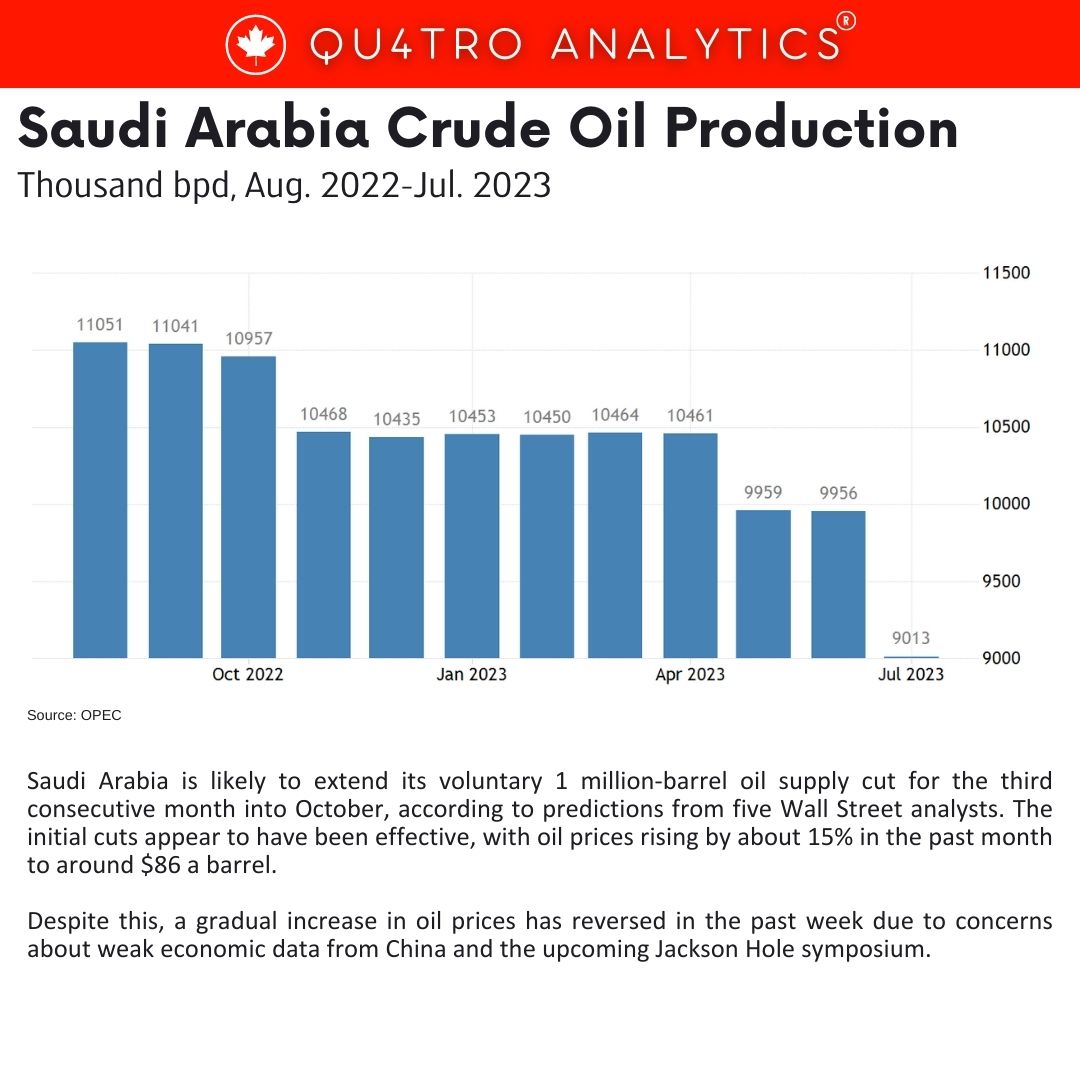
Saudi Arabia is likely to extend its voluntary 1 million-barrel oil supply cut for the third consecutive month into October, according to predictions from five Wall Street analysts. The initial cuts appear to have been effective, with oil prices rising by about 15% in the past month to around $86 a barrel. Despite this, a gradual increase in oil prices has reversed in the past week due to concerns about weak economic data from China and the upcoming Jackson Hole symposium.
The current Brent crude prices of $82.71 are considered too low for Saudi Arabia, as the country needs oil prices at around $100 a barrel to balance its fiscal budget. This provides the country with further incentive to maintain tight supplies in the market. Richard Bronze, an analyst at consultancy Energy Aspects, has stated that Saudi Arabia is likely to extend the supply cut through October. The cautious approach is influenced by the weaker oil market conditions in the first half of the year, and the country will want to see a significant decline in global inventories before considering unwinding the additional cuts.
 Analysts from brokerage PVM Oil and Saxo Bank have also speculated that a potential resumption of oil production from Iraq’s Kurdistan region might lead Saudi Arabia to withhold additional supplies to the market for the time being. Despite these uncertainties, oil markets are expected to tighten gradually, leading to an increase in prices as the months progress.
The International Energy Agency (IEA) has predicted a global oil shortage of approximately 1.7 million barrels per day during the second half of the year. Experts at Standard Chartered have forecasted a supply deficit of 2.81 million barrels per day in August, 2.43 million barrels per day in September, and over 2 million barrels per day in November and December. Their projections also suggest that global inventories will decrease by 310 million barrels by the end of 2023 and another 94 million barrels in the first quarter of 2024, contributing to higher oil prices. The experts anticipate that Brent prices will rise to $93 per barrel in the fourth quarter.
Interested in learning more?
Sign up for Top Insights Today

Top Insights Today delivers the latest insights straight to your inbox.
You will get daily industry insights on
Oil & Gas, Rare Earths & Commodities, Mining & Metals, EVs & Battery Technology, ESG & Renewable Energy, AI & Semiconductors, Aerospace & Defense, Sanctions & Regulation, Business & Politics.
Read more insights

US lawmakers urge Volkswagen to halt operations in Xinjiang amid forced labor allegations
In response to reports that thousands of Volkswagen Group vehicles containing parts made by forced labor in China were held at U.S. ports, Representative Mike Gallagher and Raja Krishnamoorthi, the chair and top Democrat, respectively, of a U.S. House Committee on China, urged Volkswagen…
China’s solar giants face losses as overcapacity and price wars erode profits
China’s major solar manufacturers are facing a challenging market, posting substantial losses due to severe overcapacity and an ongoing price war. The top solar panel producer, Longi Green Energy Technology Co., reported its fourth consecutive quarterly loss, with a net deficit of 1.26 billion yuan ($177 million) compared…
Chinese businesses brace for yuan pressure amid trade tensions
China’s companies and investors are bracing for a currency landscape dominated by two expectations: the yuan will stay largely stable in the near term, but is likely to weaken later as the weight of U.S. trade policies bears down. A steady buildup of dollar deposits in Chinese banks and growing appetite for currency hedging highlight how local firms and households are positioning for what could be a volatile road ahead.
The People’s Bank of China (PBOC) finds itself caught in a delicate balancing act. While it has worked methodically this year to keep the yuan from swinging too sharply, the reality is stark: any sudden move—whether stronger or weaker—could prompt an avalanche of foreign-exchange transactions. If the yuan strengthens abruptly, corporates and exporters might rush to sell dollars to lock in better rates. If it slips too quickly, they could scramble to convert yuan into dollars to protect themselves.