
Tesla planning to produce and sell battery storage systems in India
- September 22, 2023
- Posted by: Quatro Strategies
- Categories: EVs & Battery Technology, India
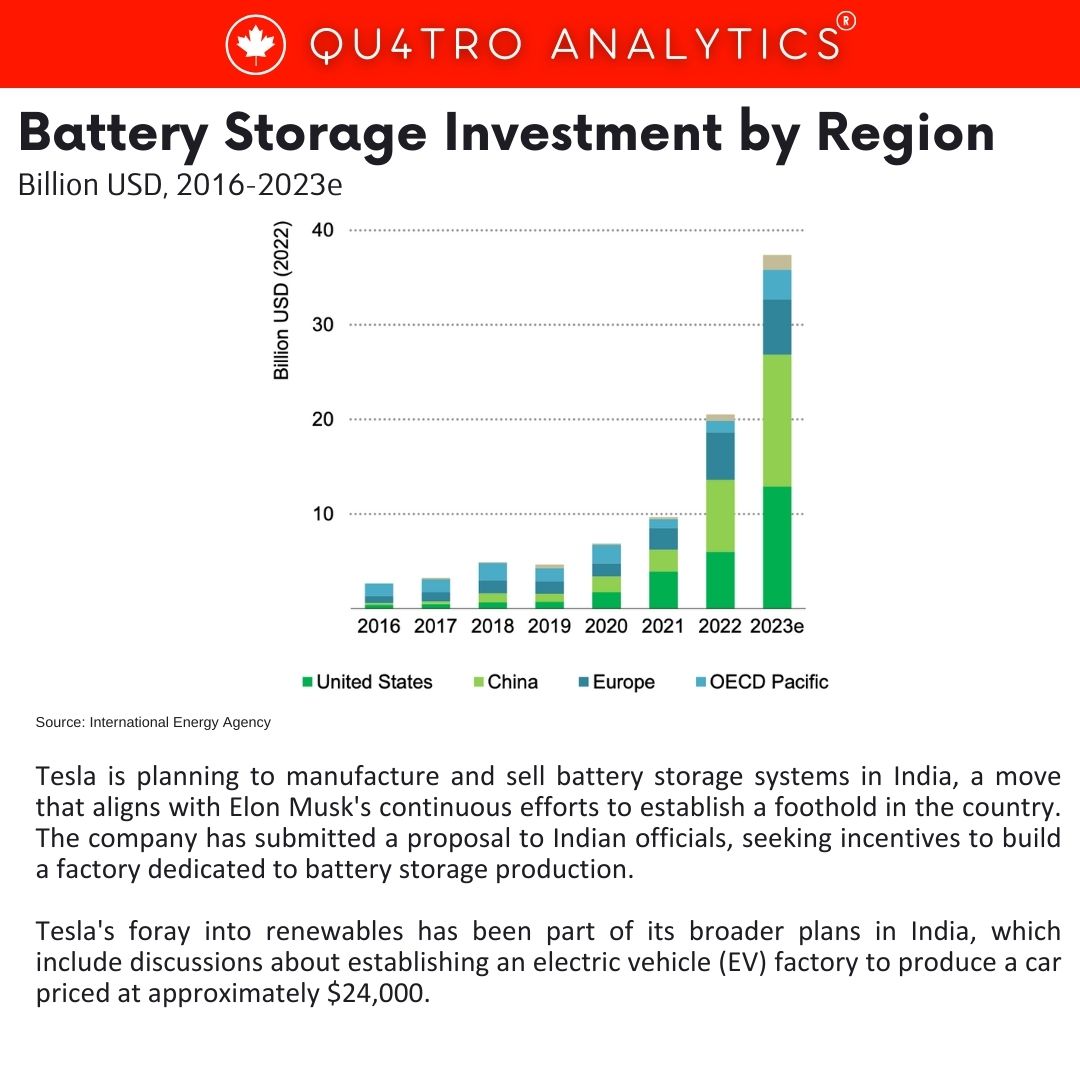
Tesla is planning to manufacture and sell battery storage systems in India, a move that aligns with Elon Musk’s continuous efforts to establish a foothold in the country. The company has submitted a proposal to Indian officials, seeking incentives to build a factory dedicated to battery storage production. Tesla’s foray into renewables has been part of its broader plans in India, which include discussions about establishing an electric vehicle (EV) factory to produce a car priced at approximately $24,000.
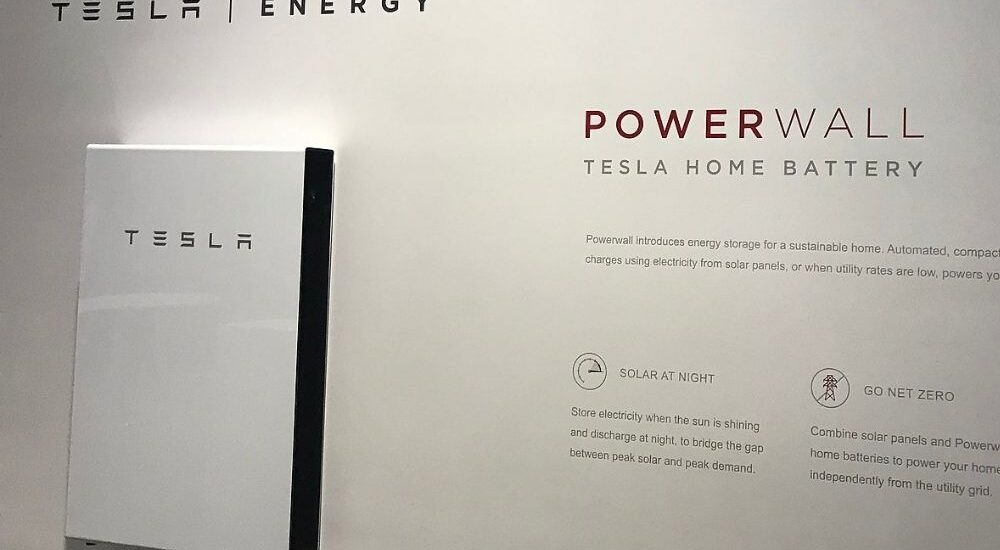
In recent meetings held in New Delhi, Tesla proposed supporting India’s battery storage capabilities through its “Powerwall,” a system designed to store power from solar panels or the grid for use during the night or during outages. The Powerwall proposition is intended to target both residential and industrial customers for Tesla’s battery storage systems.
 While Tesla had sought several incentives to establish a battery storage factory in India, officials conveyed that these incentives would not be available. However, they indicated that the government could support the initiative by creating a fair business model through subsidies for purchasers of such products.
India is grappling with electricity shortages during peak times despite bolstering its electricity supplies to towns and villages. The country remains heavily reliant on coal-based power generation due to the cost and limited prevalence of storage technologies. India has set an ambitious target to increase its non-fossil fuel power capacity to 500 GW by 2030 from the current 186 GW.
Tesla’s Powerwall, a compact unit designed for domestic and light commercial use, could be a solution to India’s power storage challenges. It can be installed in garages or outside houses, enabling storage and efficient utilization of solar or grid power.
However, Indian officials have highlighted the necessity for Tesla to work on reducing the cost of its battery storage products to make them accessible to a wider market. Tesla is eager to participate in India’s transition to cleaner and more efficient energy systems, with the Powerwall as a potential tool to address power storage needs in the country.
By QUATRO Strategies International Inc.
QUATRO Strategies International Inc. is the leading business insights and corporate strategy company based in Toronto, Ontario. Through our unique services, we counsel our clients on their key strategic issues, leveraging our deep industry expertise and using analytical rigor to help them make informed decisions to establish a competitive edge in the marketplace.
Interested in learning more?
Sign up for Top Insights Today

Top Insights Today delivers the latest insights straight to your inbox.
You will get daily industry insights on
Oil & Gas, Rare Earths & Commodities, Mining & Metals, EVs & Battery Technology, ESG & Renewable Energy, AI & Semiconductors, Aerospace & Defense, Sanctions & Regulation, Business & Politics.
Read more insights
U.S. entity list reaches deep into China’s battery supply chain
Trade officials from the two largest economies held a video call on Thursday that both sides described in cordial terms. On Friday the Department of Homeland Security added 43 Chinese companies to the Uyghur Forced Labour Prevention Act Entity List, a 30 percent expansion and the largest in the statute’s five-year history, reaching into aluminium, lithium, gold, capacitors, textiles, pharmaceuticals and snack food.
Beijing’s Commerce Ministry noted the sequence explicitly on Saturday, condemning the action as an unfounded unilateral sanction arriving one day after what it called a constructive exchange, and promising necessary measures to protect Chinese firms without specifying them. Whether the timing was deliberate or merely bureaucratic, the message received in Beijing was the same.
Norway’s Equinor to proceed with UK oil project, boost LNG supply to India
Norwegian oil and gas producer Equinor has confirmed its commitment to developing the Rosebank oil and gas field, one of Britain’s last major oil reservoirs, despite ongoing opposition from climate activists. Speaking on the sidelines of the India Energy Week conference in New Delhi, Equinor’s UK manager, Alex Grant, emphasized…
Power Corp of Canada shuts down China investment unit amid economic slowdown
Power Corporation of Canada (Power Corp) has closed its China investment unit and dismissed all staff, marking the latest retreat by a Western financial firm amid economic challenges in China. Power Sustainable, the asset management arm of Power Corp managing $4.5 billion globally, began laying off its 17 local staff in recent…