
Italy’s Eni starts oil and gas production off Ivory Coast
- August 29, 2023
- Posted by: Quatro Strategies
- Categories: Africa, Oil & Gas
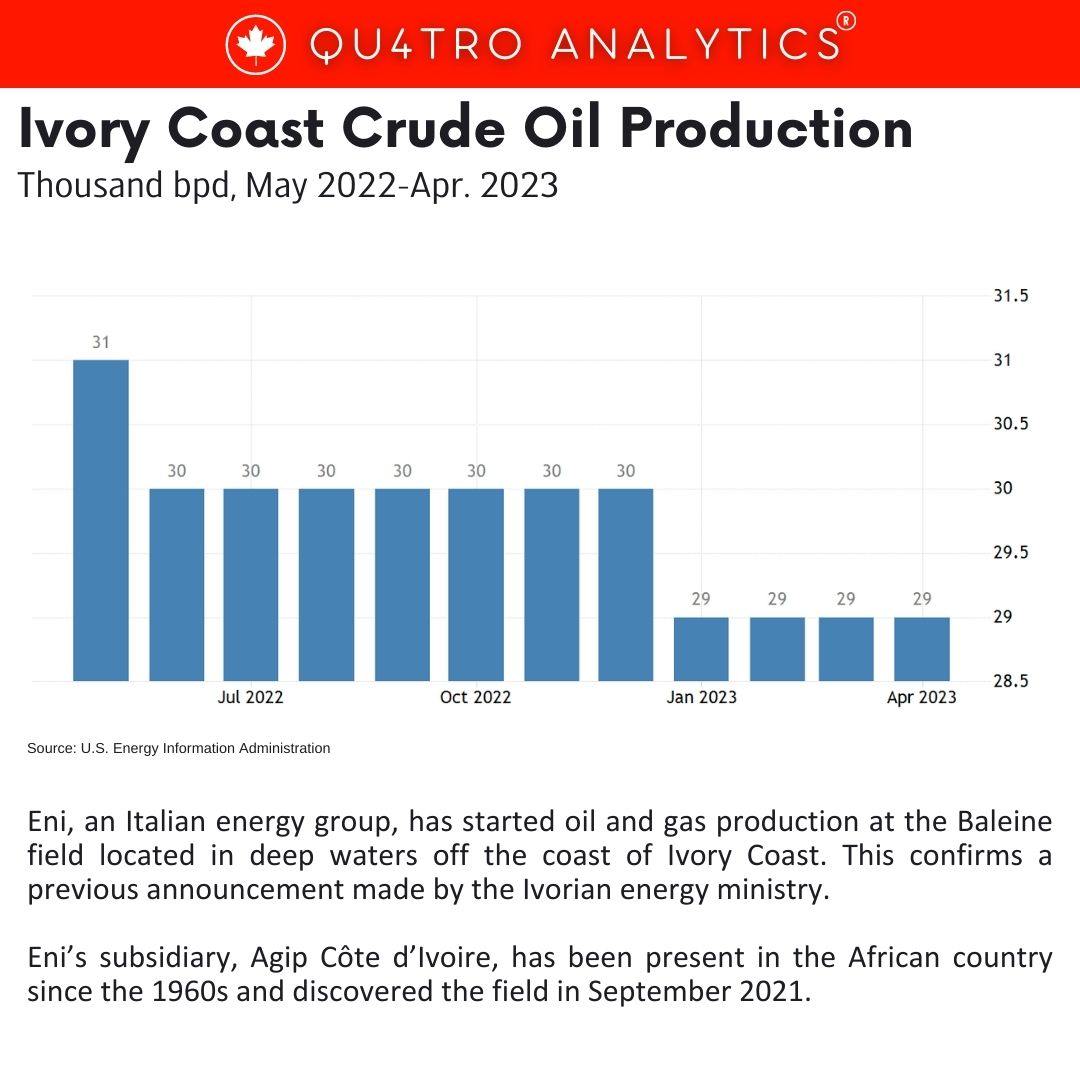
Eni, an Italian energy group, has started oil and gas production at the Baleine field located in deep waters off the coast of Ivory Coast. This confirms a previous announcement made by the Ivorian energy ministry. Eni’s subsidiary, Agip Côte d’Ivoire, has been present in the African country since the 1960s and discovered the field in September 2021.
Eni CEO Claudio Descalzi stated that the first oil from Baleine is a significant milestone for the company. They have achieved an industry-leading time-to-market of less than two years from the declaration of commercial discovery.
 During the initial phase, production will occur through a production storage and offloading vessel that can handle up to 15,000 bbl/d of oil and around 25 Mscf/d of associated gas. The second phase is expected to begin by the end of 2024 and will increase field production to 50,000 bbl/d of oil and approximately 70 Mscf/d of associated gas. The third development phase aims to increase field production to 150,000 bbl/d of oil and 200 Mscf/d of gas.
In Ivory Coast, Eni holds interests in the CI-101 and CI-802 blocks, where the Baleine field extends, as well as in four other deep-water Ivorian blocks. Petroci Holding is a partner in all these blocks.
Interested in learning more?
Sign up for Top Insights Today

Top Insights Today delivers the latest insights straight to your inbox.
You will get daily industry insights on
Oil & Gas, Rare Earths & Commodities, Mining & Metals, EVs & Battery Technology, ESG & Renewable Energy, AI & Semiconductors, Aerospace & Defense, Sanctions & Regulation, Business & Politics.
Read more insights
Rising premiums for West African crude signal strong demand from Europe
Europe’s oil refineries are increasing their crude oil purchases in response to a surge in diesel prices and disruptions to imported shipments from the Middle East. This situation has led to a rise in the cost of physical barrels of oil, particularly for key West African grades such as Forcados and Egina…

Challenges mount for UK businesses as Red Sea disruptions take toll
The British Chambers of Commerce recently conducted a comprehensive survey, revealing a notable impact of disruptions in the Red Sea on various sectors of the UK economy. According to the survey findings, a significant majority of exporters and manufacturers across the country have encountered…
Linde commits $2 billion for Canada hydrogen facility to fuel Dow’s Path2Zero complex
Linde, the industrial gases giant, announced on Tuesday its plan to invest over $2 billion to construct a clean hydrogen production facility in Alberta, Canada. This project is designed to supply hydrogen to Dow’s Path2Zero production complex, marking a significant move toward reducing carbon emissions in industrial processes…